By Caitlin Follman, Jonah Gotkin, Lydia Loglisci, Rachel Stickelmaier, Isabella Vesperini, McKenzie Vitale and Max Lewis of Fox59/CBS4
AVON – A police officer turns down the music in his car as he pulls into the parking lot in front of Planet Fitness in Avon. He walks up to the car he’s pulled over.
“The reason for the stop today, that frame on the back of your plate, that license cover, it’s illegal,” said Officer Shawn Miller of the Avon Police Department to the 19-year-old driver, according to bodycam footage obtained by Fox 59. “It’s reflecting the sun so that we can’t see. Just the cover of it. You just got to get a different cover, all right?”
The driver hands over what appears to be his state ID, registration and insurance documents and waits. Miller takes a photo of the man’s permit, and appears to send it in a group chat and exits his vehicle.
Two federal agents stand next to the driver’s car. The driver stays mostly silent as he is handcuffed, patted down and taken to another truck in the Planet Fitness parking lot.
“Whatever y’all need, I’m here for it,” Miller tells the federal officers.
Miller walks back to his car without issuing a traffic citation as the driver is taken away by Immigration and Customs Enforcement.
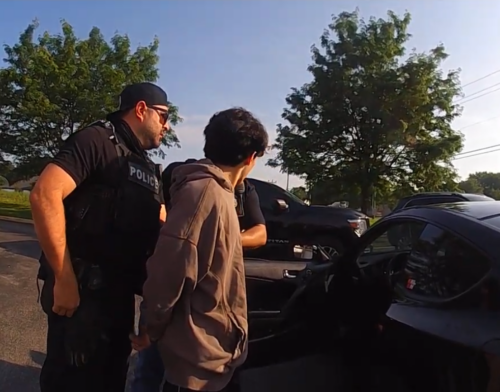
Federal agents take a 19-year-old man into custody after a traffic stop in Avon. (Photo from Avon bodycam footage)
The July 2025 Avon operation that snared David is one of the documented coordinated local enforcement actions done in cooperation with the U.S. Immigration Law Enforcement and Agencies. In July, the Whitestown Police Department also worked with ICE to perform traffic stops. An Indiana State Police-led operation made 223 arrests along Northwest highways as of October 2025.
ICE involvement across the United States has become more visible to the public, looking different in each state.
The Whitestown Police Department declined a request to interview Police Chief Rolston about the operation but Public Information Officer John Jurkash said, in an email, the traffic blitz was a “single, time-specific enforcement operation.”
The department partnered with ICE on July 31, 2025 for an enforcement blitz within town limits that lasted between three and four hours, Jurkash said, and traffic stops were made based “solely on observed violations,” with ICE personnel on standby. When an officer encountered an unlicensed driver, they notified ICE, who decided what further enforcement was needed.
The Avon Police Department did not respond to a request for an interview.
The Arnolt Center for Investigative Journalism and FOX59/CBS4 contacted more than 520 local agencies in Indiana about coordinated activities with ICE and 430 never responded.
The police departments and sheriff’s offices that responded had little to no contact with ICE. Only seven said they have cooperated with immigration authorities.
As of May 1, 2026, 31 agencies signed up for ICE’s 287(g) program that grants “local law enforcement officers the authority to perform specified immigration officer functions under ICE’s direction and oversight.” All of those agencies joined in the last year, with 17 signing up in 2026.
Gov. Mike Braun last year signed an executive order directing state agencies to fully cooperate with ICE and “encouraged” local agencies to do the same. But a new state law removes local discretion and compels police departments and sheriff’s offices to comply more with federal immigration enforcement.
Federal agents take a 19-year-old man into custody after a traffic stop in Avon. (Photo from Avon bodycam footage)
Inside the blitzes
FOX59/CBS4 and the Arnolt Center obtained a series of body camera videos from the traffic enforcement activities conducted in July by the Avon and Whitestown police departments, giving an inside look at what happened when vehicles were pulled over.
In Whitestown, an officer pulls over a maroon pickup on the southbound shoulder of I-65, citing an improperly placed license plate. The driver hands over his license and registration and the officer sends a photo of the documents in a group chat,according to video obtained by FOX59/CBS4 and the Arnolt Center.
The officer remains in the vehicle for about 10 minutes until three agents arrive. The driver and a passenger are detained.
That same day on Anson Boulevard near the Amazon Fulfillment Center, an officer pulls over a white Toyota sedan for running a red light.
The officer collects the driver’s passport, the passenger’s license and the vehicle registration. He takes photos of both the ID and passport and types on his phone, according to partially obscured video provided by the Whitestown Police Department.
The two men in the Toyota wait on the side of the road for roughly 11 minutes.
“Yeah, they’re coming to grab them. I’ve got two in there,” the officer says to someone out of the camera’s view. “They’re good. They don’t speak any English but they’re good.”
An officer with an ICE badge arrives.
“I’m going to take them both,” the officer with the ICE badge said.
In Avon, an officer pulled over a white work van for going 55 in a 45 after previously observing it at a nearby gas station. Drivers and passengers were asked for a form of identification, specifically their passports first, then licenses.
Zachary Cormier, a law professor at Indiana University Indianapolis who studies criminal procedures, said the officer’s action is legal as a “pretextual stop,” which means an officer can pull over a vehicle for a traffic violation after previously observing a vehicle for suspicions of any criminal activity.
“They’re observing someone in public, in a public place,” Cormier said.
The Fourth Amendment does not allow officers to extend the stop to conduct immigration inquiries unless new reasonable suspicion arises, Cormier said. The Supreme Court ruled that officers can ask about immigration status during a lawful detention without any violations of constitutional rights, as long as those questions do not extend the period of the detention, he said.
During the stop, the driver asks the officer if he is with immigration. The officer said he’s not with immigration but rather Avon Police.
“That seems to be an accurate answer,” Cormier said when reviewing the bodycam footage. He compares it to a local officer being asked whether he works for the Drug Enforcement Administration but later contacting federal agents. But a driver asking if he’s working with federal agents could be revealing to an officer.
“If the [driver]…asks him right off the bat if he’s from ICE enforcement, that’s probably a sign that the guy’s worried about his immigration status,” Cormier said. “That might be actually a factor that, you know, that leans towards… an ICE enforcement agent’s investigation or suspicion about an immigration problem.”
In a different video, a Whitestown officer pulls over a black Chevy sedan on the side of I-65, telling the driver that the license plate needs to go on the back of the car, not in the back window. The driver hands over his registration, but the officer says he has trouble looking him up and obtains his Social Security number instead.
Three DHS agents arrive and after one approaches his car, the driver argues with the Whitestown officer about the stop.
“That’s not right what you guys are doing,” the driver says.
“What’s not right?” the officer asks. “So here’s the deal. I made a traffic stop. When I ran your information, immigration was in the area, and it hit their system, and that’s why they showed up.”
The officer claimed that the federal agents at the scene were checking if the driver had an active federal warrant. The officer confirms his driver’s license is indeed active.
A few minutes later, the officer hands the driver his registration, and tells him he won’t be getting a ticket.
“What happened?” asked the person on the phone with the driver.
“I’ll be home shortly,” the driver replied.
A life upturned
David, the 19-year old driver detained outside an Avon Planet Fitness, hasn’t been back home since that day in July when he was arrested. FOX59/CBS4 and the Arnolt Center are using an alias to protect his family.
Kristen Coffey, his defense attorney, said after he was pulled over in July, officers took him to the ICE Enforcement and Removal Operations office in Indianapolis. There, he was able to call his mom, who then called Coffey. Coffey spoke with an ICE officer, who said he was processing him for expedited removal because he’d been in the country for less than two years without a hearing to continue his application, which was originally supposed to be part of his mom’s asylum application.
As an unaccompanied minor, David had the right to seek asylum and stay in the U.S under his mother’s preexisting application.
From Indianapolis, David spent about 48 hours at the Clay County Jail before winding up in Campbell County Detention Center in Kentucky where he’s sat for the last nine months.
In January, on David’s behalf, Coffey filed a habeas corpus petition in the United States District Court East District of Kentucky arguing he’s being improperly detained. That case is still pending.
Coffey said she isn’t allowed to schedule in-person appointments with him, and has only communicated via video and phone calls.
He spent his 20th birthday in a jail cell. And Christmas. And New Year’s.
“He just, I mean, sits there all day,” Coffey said. “He lost a lot of weight. His hair’s gotten thin. He used to have curly hair and his hair just kind of looks listless, and he does too.”
Local ICE cooperation increasing
Cooperation is growing in Indiana as more agencies ink agreements for local police departments to perform immigration officer functions.
There are four models under this revised section of the 287(g) Immigration and Nationality Act, and Indiana agencies has adopted three of them:
- The jail enforcement model allows for local officers to process undocumented individuals who have existing or pending criminal charges.
- The task force model allows for officers to enforce immigration authorities while conducting routine police tasks.
- The warrant service officer model allows immigration officers to train local police officers to carry out immigration-related arrest warrants on people already in their jail, instead of ICE officers themselves.
The current police departments that are complying with ICE under the 287(g) Task Force Model include the Angola Police Department as well as Cadiz, Corydon, Greens Fork, Greensboro, Kennard, LaGrange, North Salem, and Stinesville Police Departments. Others include the Hendricks County Prosecutors office, as well as the Indiana State Police Department.
The Indiana State Police is one of various state agencies that cooperates with ICE, and have expanded their presence in Northwest Indiana. Lieutenant Colonel Allen Williamson said state officers and ICE agents are stationed at truck scales to check the status of drivers as they go through.
When operations started last year, Williamson said last fall, ICE took custody of 207 immigrants in the span of about one and a half months.
“It’s just exposed how many illegal aliens that don’t even speak our language are out driving semi tractor trailers,” he said, during an interview.
More changes on the horizon
A bill passed in March expanded local cooperation with federal immigration enforcement. It allows punishment for businesses who willingly and knowingly hire undocumented immigrants. It would also require county jails to comply with ICE detainer requests; jails would need to hold an individual for 48 hours to allow ICE agents enough time to come and pick them up. Sheriff Ruben Marté is suing Indiana Attorney General Todd Rokita over this bill. He claims that ordering officers to comply with the detainer requests is unconstitutional.
Rep. Chris Jeter (R-Fishers), one of four sponsors of the bill, said taxpayer money should go to protecting Hoosiers first. He said thinks this bill will help prioritize Hoosiers’ safety first.
“We’ve got to be sure that we’re putting our own citizens first, that we’re protecting our neighborhoods,” he said. “And I think a big key part of that is working with our federal counterparts…We’re not going to let folks just sort of run rampant here.”
Jeter said that there are two conflicting interests at stake with this bill – citizens and immigrants. He said he thinks faith-based groups and nonprofits should focus on supporting immigrants and the government should serve its citizens first.
“You’ve got people that are trying to make a better life for themselves, coming from, some of them,very terrible situations in their home countries. I totally respect that, and I have sympathy for that,” Jeter said. “You know, we also have taxpayers in the state that also have seen record inflation, that are working hard to try to pay their bills, put their kids through school, and, you know, at the end of day, like we have a duty to those people, in my opinion, first.”
Lawyer: David in U.S. legally but remains behind bars
David’s primary goal since coming to the United States has been taking care of his mother, but that’s been impossible from a Kentucky jail cell.
“It’s been heartbreaking, especially because it’s just him and his mom,” Coffey said. “The first thing he did with his money, you know, when he got a job was buy her a car, make sure she was taken care of. And then he worried about himself. Then he got himself a car and she had to sell his car to pay the bills.”
His mom left their home country several years ago. On her way to the United States, she stopped in Mexico for a few years due to a health emergency that required surgery. Coffey said her hope was that once she arrived in the country, she could save enough money to bring her son over.
About six months after she arrived as an asylum-seeker in the United States, her son was able to come legally as an unaccompanied minor. He’d been living at his grandma’s house and even had to drop out of high school because it wasn’t safe. He arrived in the country and started living with his mom in 2023.
But he couldn’t enroll in high school, Coffey said, as he was turning 18 too soon. He instead took high school-equivalent classes at an Excel Center. They moved around a couple times before settling in Avon.
They were only in Avon for about two months before David’s arrest on his way to the gym.
David has no criminal history, Coffey said. Both he and his mom had driver’s licenses, Social Security numbers and work permits. David even had his driver’s log from his learner’s permit in the glove compartment when he was pulled over.
“Everything was what most people would say was legal,” she said. “They had permission to be here.”
Charlie Herman and Carson Johnson contributed research and reporting.
This story was written by journalists at the Arnolt Center for Investigative Journalism at Indiana University in partnership with Fox 59/ CBS 4. Caitlin Follman, Jonah Gotkin, Charlie Herman, Carson Johnson, Lydia Loglisci, Rachel Stickelmaier, Isabella Vesperini and McKenzie Vitale are students with the Arnolt Center.